
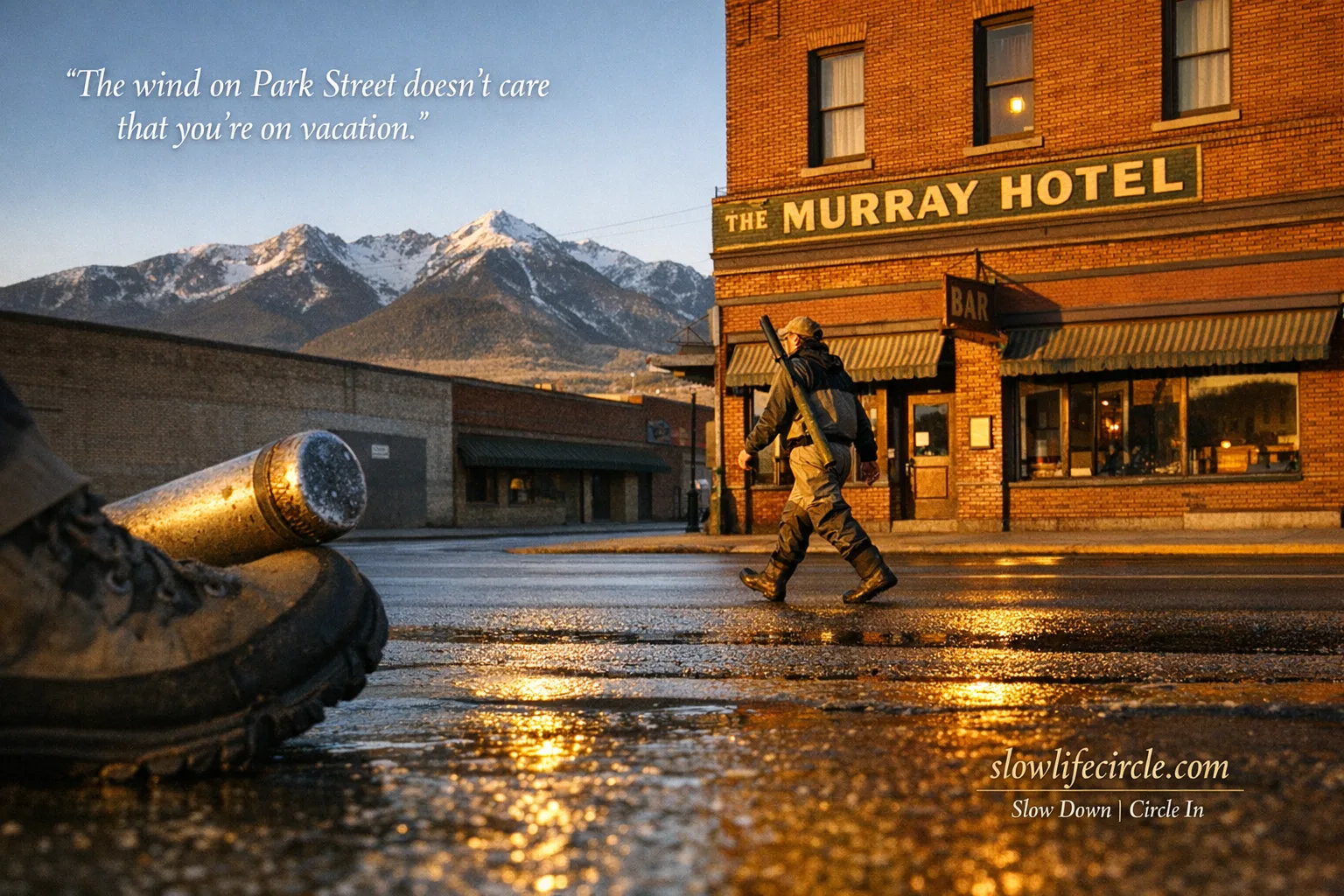
Livingston, Montana is routinely dismissed as a staging post for Yellowstone, and the generic travel content. This article corrects that by operating at the level of specificity the town actually deserves.
KEY TAKEAWAYS
1. The Yellowstone River runs right through town — 14 public fishing access sites, world-class spring creeks just south, and guided float trips that work for total beginners.
2. Livingston has more than 20 galleries and art spaces in its walkable downtown; the Livingston Gallery Association hosts Art Walks on the 4th Friday of June, July, August, September, and November (5:30–8 pm).
3. The Livingston Roundup Rodeo (July 1–4) is Montana’s oldest PRCA rodeo, now in its 101st year, drawing 10,000+ spectators and ranked among the top July 4th purses in the nation.
4. The Murray Hotel, open since 1904, was named one of Anthony Bourdain’s top 10 hotels worldwide; the Murray Bar has been Livingston’s social anchor for over a century.
5. Day trips from Livingston include Yellowstone National Park (56 mi), Chico Hot Springs (22 mi), Big Timber (30 mi east), and Bridger Bowl ski area (25 mi).
6. Pine Creek Falls Trail — 17 miles south — is Livingston’s most popular short hike: 3.2 miles round-trip with 741 ft of gain, family-friendly, and genuinely stunning.
7. Livingston sits between Bozeman (26 mi west) and Billings (116 mi east), making it the least-crowded, most interesting stop on any Montana road trip.
It’s 7 a.m. on a Tuesday in July. You’re standing on Park Street, and the wind — the wind — is already doing what Paradise Valley winds do, which is arrive without warning and leave whenever it feels like it. Two people in waders are heading south toward the river. A guy in paint-stained jeans is unlocking a gallery. Somebody’s border collie is already in someone else’s truck. The coffee is strong, the mountains are right there, and you have the faint, slightly alarming feeling that this town is going to require more than a day.
You’re right. It will.
Livingston, Montana has a search traffic problem: everyone types “things to do in Livingston MT” and lands on a listicle that tells them to “visit the Yellowstone River” (which river, which access, which stretch?) and “explore the art galleries” (all twenty of them, apparently, in one vague gesture). What nobody tells you is which gallery opened a new show, when the Art Walk is, or that the rodeo happening on July 4th weekend has the 10th-highest purse in the nation for an Independence Day PRCA event — drawing 10,000+ people to an open-air arena next to the river, which is as good as it sounds.
This guide fixes that. You’ll leave knowing exactly where to be, when to be there, and what the locals are doing while the tourists circle the same two blocks. And if you’re considering actually moving here — which, fair enough, happens to people — you’ll want to pair this with our honest relocation guide to Livingston before you put your house on the market.
Quick Answer: Five Things That Make Livingston Unlike Anywhere Else
Here’s the condensed version for those of you who read introductions in the car. The Yellowstone River — the longest free-flowing river in the lower 48 — runs right through town, and you can walk to a public fishing access in ten minutes from Main Street. Downtown has more than 20 working galleries and art spaces in three walkable blocks, anchored by the Danforth Museum of Art. The Murray Hotel, open since 1904, was named one of Anthony Bourdain’s top 10 hotels on earth, and the bar next door has been the social center of southwest Montana ever since. Every July 4th weekend, the Livingston Roundup Rodeo — Montana’s oldest, now in its 101st year — turns the Park County Fairgrounds into 10,000 people watching the best PRCA cowboys in the country. And Yellowstone National Park is 56 miles south, making Livingston the best-positioned base camp in the region by a significant margin. That’s the setup. Here’s everything else.
On the Water: Fly Fishing, Floating, and the Yellowstone River
The Yellowstone River doesn’t care about your schedule. Plan around it, not the other way around.
If you’ve never been to Livingston before, here is the first thing to understand: this is not a town that happens to have a river nearby. This is a river town that happens to have a Main Street. Dan Bailey’s Outdoor Co. — a fly shop institution since 1938, which makes it older than most of the people reading this — has a phrase for it: “the cultural epicenter of trout fishing in the West.” Walk ten minutes from the shop and you’re standing at the bank of the Yellowstone. That’s not marketing copy. That’s just geography.
The Yellowstone River: What You Actually Need to Know
The Yellowstone is big — over 200 feet wide in most stretches — which means wading is mostly a spectator sport. You’ll want a drift boat or a raft, and a guide the first time unless you already know what “the tricky turn at the 9th Street Bridge” means (hint: it’s not tricky for experienced boaters, but it has eaten a few rental kayaks). The fishery is year-round with no closed season, but realistically the prime window runs from late June through mid-August and again through the fall. Spring runoff — typically May through mid-June — turns the river into chocolate milk and closes most float options.
The “town stretch” from Mallard’s Rest to the US-89 bridge is genuinely worth your time in late April through early May (Mother’s Day Caddis hatch — you’ll know it when you see it) and again in late September. Brown trout, rainbow trout, and the occasional Yellowstone cutthroat populate this stretch. If you want solitude, fish downstream of town, where the banks spread out and most anglers chase higher fish counts south in Paradise Valley instead.
The Spring Creeks: Where the Serious Anglers Go
A few miles south of town, DePuy’s Spring Creek, Armstrong’s, and Nelson’s spring creeks represent some of the most technically demanding — and celebrated — trout fishing in the American West. DePuy’s, in particular, is a three-mile stretch of private water that requires a reservation for both guided and non-guided fishing. It is not cheap. It is also not overrated. Experienced anglers who’ve fished it once tend to book the following year before they leave. Access information and current pricing are available through outfitters including Yellowstone Angler and Yellowstone Country Fly Fishing.
The Fly Fishers International Museum
The Fly Fishers International Discovery Center on the south end of town is the only facility of its kind in the country — live fish exhibits, a Yellowstone cutthroat trout tank, cold-water and warm-water aquarium displays, and free casting and fly-fishing classes in summer. If you’re bringing someone who’s curious but not yet converted, this is the one-stop case for why fly fishing is actually interesting to watch even if you’re not doing it.
“The Yellowstone River is over 200 feet wide in most parts. It begins in Yellowstone National Park, flows through Paradise Valley, and is backed by four distinct mountain ranges. Because it drains such a large area of high mountain country, it experiences prolonged runoff well into June and sometimes July.” — Montana Fly Fishing
When to Fish What
| Season | Conditions | Best Option |
|---|---|---|
| April – early May | Clear water, rising temps, Mother’s Day Caddis hatch | Town stretch wading, early float |
| Mid-May – mid-June | Spring runoff — muddy, blown out | Spring creeks (DePuy’s, Armstrong’s, Nelson’s) |
| Late June – August | Prime: clear, warm, high fish activity | Paradise Valley float, spring creeks |
| September – October | Excellent: fall brown trout movement, cooler temps | Full river, town stretch, Boulder River |
| November – March | Cold, icy banks, Paradise Valley winds | Lower river stretches, spring creeks on calm days |
In the Mountains: Hiking Near Livingston MT
The Absarokas rise directly out of Paradise Valley. Some trails start at a pleasant waterfall and end, if you let them, at a 9,200-foot alpine lake with nobody else in it.
Livingston sits at the convergence of four mountain ranges — the Absarokas, the Gallatins, the Bridgers, and the Crazies — which is an embarrassment of hiking riches for a town of 8,000 people. The Custer Gallatin National Forest alone provides access to hundreds of miles of Forest Service trails via several dozen trailheads, most within an hour of downtown.
Pine Creek Trail: The One You Do First
About 17 miles south of Livingston, Pine Creek Trail is the area’s most-visited hike and earns it without apology. The trail runs into the Absaroka-Beartooth Wilderness and offers three distinct experiences depending on how much vertical punishment you’re willing to accept.
The easy version — 3.2 miles round-trip, 741 feet of gain, about 90 minutes — takes you to Pine Creek Falls through a lodgepole forest with impressively minimal effort. The trailhead is well-signed off Luccock Park Road, which branches from MT-540 (East River Road) about 8 miles south of Livingston. Expect company: this is the most popular short hike in the area, and for good reason. Arrive before 9 a.m. on summer weekends to guarantee parking.
The hard version — 9.8 miles round-trip, 3,654 feet of gain, a genuine all-day commitment — continues past the falls through a series of steep switchbacks, burn areas, and cascading water to Pine Creek Lake at 9,200 feet. The 32-acre lake sits in a cirque below the 10,941-foot summit of Black Mountain and is stocked with Yellowstone cutthroat trout. The reward-to-suffering ratio is excellent. Bring poles, waterproof boots (there are water crossings), and considerably more snacks than you think you need.
Other Trails Worth Your Time
The Cemetery Trail Loop is the local’s version of a quick morning walk — close to town, reasonable grade, and the kind of sweeping view of the Absarokas that makes you feel better about everything before 8 a.m. For something more ambitious, the Sacajawea Peak trail offers panoramic views across four mountain ranges. For a completely different experience, the Paradise Valley Scenic Byway itself functions as a scenic drive-hike hybrid — pullouts every few miles, the Yellowstone visible most of the way, and enough scenery per mile to justify slowing down considerably.
The Arts Scene: Galleries, The Literary Legacy, and the Livingston Art Walk
Livingston calls itself the “HeART of Art in Montana.” This is either a clever pun or typographic enthusiasm. Either way, the galleries are real.
Here’s what the generic tourism guides miss: Livingston’s art scene isn’t decorative. It’s structural. Writers have been living here since at least the 1970s — the proximity to Yellowstone, the light, the affordable (relative to Jackson Hole) real estate, and the fact that a town with a serious fly fishing river and a serious bar scene is essentially paradise for a certain type of person with a typewriter. SAH Archipedia describes Livingston as “a railroad town now known for its large literary population.” That’s academic for: the writers came and stayed.
The Art Walk: How It Actually Works
The Livingston Gallery Association coordinates five Art Walks per year, held on the fourth Friday of June, July, August, September, and November (the November walk falls on the 21st for the holiday season kickoff). All walks run 5:30 to 8 p.m. The 2025 season opened June 27th. Maps of participating galleries are available at all LGA locations and the Chamber of Commerce.
The 2025 LGA membership includes 20 galleries and creative spaces: Blue Door Gallery, Cactus Blossom Collective, Curated Closet, the Danforth Museum of Art, DeYoung Gallery, Frame Garden, Joe Wayne Gallery, the Livingston Center for Art and Culture, Medicine Bird, Mordam Art, Out of the Blue Antiques, Park Photo, Parks Reece Gallery, Placed, Robert Osborn Gallery, Soul Dog Gallery, Strata-Editions, Visions West Contemporary, Wheatgrass Books, and Yellowstone Hat Co. Nearly all are within three blocks of each other in historic downtown.
The Galleries Worth Walking Into Any Day
The Danforth Museum of Art (106 N Main Street) is the anchor — a nonprofit art center operated by Park County Friends of the Arts that has been running since 1974. Group shows rotate monthly and include nationally known artists alongside emerging regional talent. January through March, the Danforth runs a film festival featuring eight critically acclaimed films. April brings a lecture series. It is, in short, doing far more institutional lifting than most small-town arts organizations ever attempt.
Visions West Contemporary is the commercial heavweight — the kind of gallery that shows work with real price tags attached, which in Livingston functions as both a compliment and a reliable indicator that the artist has arrived. Blue Door Gallery on Park Street maintains a permanent showcase of photography by Barbara Van Cleve, whose work on the American West has been described as definitional. Parks Reece Gallery shows Reece’s large-format wildlife and landscape paintings, which have a way of making you reconsider every mediocre wildlife print you’ve ever owned.
If you arrive outside Art Walk dates and want a single destination, the Danforth is your best starting point. It has changing shows, it’s free to browse, and the staff will tell you what’s worth seeing elsewhere that week.
The Literary Legacy
Livingston has attracted a disproportionate number of serious writers for a town of its size — a fact locals mention the way people in Nashville mention musicians: casually, and as evidence of something they don’t need to explain. The Murray Hotel and Murray Bar are central to this story. The bar has been the gathering place long enough that the fishing lore on its walls has become artifact. Elk River Books on Main Street is the kind of independent bookshop that stocks titles you didn’t know you needed; it functions as a community board, a local history archive, and occasionally a venue for readings.
Food and Drink: Named Venues, Specific Opinions, and the Murray Bar Mythology
For a town of 8,000 people, Livingston has an almost aggressive commitment to eating and drinking well.
Let’s start with the mythology, since it’s real. The Murray Bar, on the corner of Park and Second Streets, has been described as “one of the world’s finest saloons” — a characterization offered by Anthony Bourdain, who spent approximately 200 nights per year in hotels and bars and was not prone to hyperbole. The bar features 16 beers on tap, house-infused cocktails, live music from bands across the country, fishing lore on the walls, and a crowd that on any given evening includes locals who’ve been coming for forty years and people who drove in from Bozeman specifically for this. It opens early and has no particular plans to close before everyone’s satisfied.
The Murray Block
The Murray Hotel building is actually a small campus. Second Street Bistro — part of the Murray Block — is consistently cited as one of the finest restaurants in southwest Montana, with an extensive wine list, gourmet appetizers, and inventive main courses that would not seem out of place in a city with three times the population. It fills up; reservations are a genuine idea rather than a formality. Gil’s Goods operates on the other end of the block, offering gourmet groceries, deli sandwiches, and the kind of local specialty items that make you reconsider the concept of a gas-station snack. If you’re self-catering or packing for a day on the river, Gil’s is where you start.
Beyond the Murray Block
Neptune’s Taphouse deserves specific mention because it is, in fact, a sushi bar in Montana, which sounds like a setup to a joke but is instead just a good idea executed well. It also has a rooftop deck — rare in Livingston — which in July is exactly where you want to be at 6 p.m. with a cocktail. Not to be confused with Neptune’s Brewery (also Livingston, also good, different operation entirely).
Katabatic Brewing Co. brews everything on-site from scratch and pours it fresh — the kind of craft brewery that earns its reputation by doing one thing correctly rather than expanding into merchandise prematurely. Pinky’s Café handles breakfast and brunch in the cheerful, unhurried way that small Montana towns do better than anywhere — counter seating, strong coffee, and portions calibrated for people who are about to go do something physical.
For Mexican food, Fiesta en Jalisco is the local standby — festive atmosphere, reliable food, and the kind of place where nobody photographs their plate. Mustang Fresh Food and Catering offers farm-to-table dishes built on Montana ingredients, which in this context means sourcing from a landscape that is genuinely exceptional at producing beef, game, and produce at altitude.
One practical note: Livingston is not a city, and restaurants here occasionally take the concept of “hours” as a suggestion. Especially in shoulder seasons (October, April), calling ahead is never a bad idea.
FEATURED SNIPPET ──────────────────────────────────────
Livingston, Montana offers world-class fly fishing on the Yellowstone River, a walkable downtown with 20+ art galleries, the nationally ranked Livingston Roundup Rodeo (July 1–4), and easy access to Yellowstone National Park just 56 miles south. It is the rare small town that delivers equally for outdoor adventurers, culture seekers, and anyone who simply wants to eat and drink very well in a place that still feels real.
Events Calendar: What Locals Are Actually Going To
Livingston’s event calendar is not padded with “community clean-up days” and “wellness walks.” The major events are genuinely worth building a trip around.
Livingston Roundup Rodeo (July 1–4)
If you are in or near Montana over Independence Day weekend and you do not go to the Livingston Roundup, you have made a decision you will need to justify. Montana’s oldest PRCA rodeo — now in its 101st year in 2025 — is held at the Park County Fairgrounds and draws over 10,000 spectators to its open-air arena adjacent to the Yellowstone River. Montana’s Yellowstone Country reports it as the 10th-highest purse in the nation among Independence Day PRCA events — meaning the best cowboys in the country are competing here, not just in it for the trophy buckle.
The rodeo features all standard PRCA events plus WPRA barrel racing, a spectacular nightly fireworks show over the fairgrounds, and the kind of crowd energy that comes from a town that takes this seriously rather than treating it as tourist theater. General admission tickets are $25; reserved seats run $35. Tickets are available through the official Afton Tickets link on the Livingston Roundup website — buy in advance, be skeptical of resellers, and don’t pay more than face value.
The rodeo was established in 1924 when Charlie Murphy — Livingston’s own — brought 28 top bucking horses from the Madison Square Garden Rodeo back to Park County. It was one of just eight Class A rodeos in the nation by 1925. A century later, the infrastructure is better and the purse is significantly larger, but the core event is the same: real cowboys, real competition, on the river, in the wind.
Art Walk Season (June–November)
The five Art Walks run on the fourth Friday of June, July, August, September, and November from 5:30 to 8 p.m. This is not a “first Friday” gallery hop with wine and small talk — it’s a coordinated, mapped, multi-block event where galleries open receptions, artists are present, and the downtown essentially becomes a walkable arts district for an evening. The November 21st walk doubles as the unofficial holiday season kickoff. Plan dinner at the Bistro or bar time at the Murray to complete the evening.
Art Week Park County (September 21–28, 2025)
The Explore Livingston TBID lists Art Week Park County — September 21–28, 2025 — as a multi-day arts event coinciding with the fall Art Walk. This is when Livingston’s creative density becomes most visible: readings, studio tours, live music, gallery openings. Fall in Paradise Valley is also among the most spectacular seasonal windows in Montana (cottonwoods along the river, Absarokas catching first snow on the high peaks), making this the most underrated week of the year to visit.
Summerfest and Oktoberfest
Summerfest — typically late June — is the community street festival centered on Park Street, with live music, food vendors, and the general atmosphere of a town that knows it’s in the best season of the year and wants everyone to be outside for it. Oktoberfest in the fall (typically October) brings a shorter but spirited version of the same energy, plus seasonal beer.
The Danforth Film Festival (January–March)
For those who visit in winter — and Livingston in January is a specific, committed choice — the Danforth Museum runs eight critically acclaimed films through its annual film festival. Combined with the Murray Bar having fewer out-of-towners and the spring creeks remaining fishable on calm days, January is when locals will tell you the town is at its most itself.
| Event | Dates | Location | Notes |
|---|---|---|---|
| Danforth Film Festival | Mid-Jan – mid-Mar | Danforth Museum of Art | 8 films; free admission to many |
| Livingston Roundup Rodeo | July 1–4 | Park County Fairgrounds | 101st year (2025); PRCA/WPRA; buy via Afton Tickets |
| Summerfest | Late June | Park Street, Downtown | Street festival; live music |
| Art Walk #1 | 4th Friday in June | Downtown galleries, 5:30–8 pm | June 27 in 2025; maps at all LGA locations |
| Art Walk #2, #3, #4 | 4th Fri in July, Aug, Sept | Downtown galleries, 5:30–8 pm | 20 participating venues in 2025 |
| Art Week Park County | Sept 21–28, 2025 | Various downtown venues | Multi-day arts events; coincides with fall Art Walk |
| Oktoberfest | October (TBA annually) | Downtown / fairgrounds | Seasonal beers, live music |
| Art Walk #5 (Holiday) | November 21 | Downtown galleries, 5:30–8 pm | Holiday season kickoff |
Day Trip Guide: What’s Within Reach of Livingston MT
Livingston’s geography is unfair in the best way. You can do a different world-class experience every day for a week without driving more than 90 minutes in any direction.
Yellowstone National Park (56 miles south, ~1 hr via US-89)
The North Entrance at Gardiner — the only entrance open year-round — is 56 miles south of Livingston on US-89 through Paradise Valley. This makes Livingston the most practical non-resort base for Yellowstone access, and unlike Jackson Hole (the other obvious option), the town doesn’t double its prices in July and call it “peak season character.” Current conditions, entry fees, and timed-entry permits when applicable are available at the official NPS Yellowstone page. The drive south through Paradise Valley is itself worth the trip — Absaroka peaks on the left, Yellowstone River on the right, essentially uninterrupted for 56 miles.
Chico Hot Springs (22 miles south)
Chico Hot Springs Resort in Pray, Montana is 22 miles south — technically closer to Livingston than Bozeman — and provides a specific answer to the question “what do people in Livingston do on a Sunday afternoon in November?” The mineral pools are natural, the historic main lodge has been there since 1900, the dining room is legitimately good (the chicken fried steak has a reputation that precedes it), and the bar is reliably occupied by the kind of mix of ranchers, skiers, and writers you only find in southwestern Montana. Day access to the pools is available without a hotel stay; check current rates on their website before arrival.
Big Timber (30 miles east via I-90)
Big Timber is Livingston’s smaller, quieter neighbor to the east — a ranching town with a genuinely good fly shop, the Crazy Mountains rising dramatically to the north, and the Boulder River drainage offering some of the least-crowded fishing in the region. It’s the kind of place where the coffee shop knows your order by your second visit. Worth a half-day if you want to experience what southwestern Montana was like before the galleries arrived.
Bridger Bowl Ski Area (25 miles northwest)
Bridger Bowl, 25 miles northwest on the other side of the Bridger Range, is the locals’ ski area of choice — challenging terrain, no resort hotel markup, and a consistent snowpack at elevation. It’s typically open December through early April. For those visiting in winter, the combination of skiing at Bridger Bowl and evenings at the Murray Bar is one of the more complete Montana winter experiences available at a reasonable price.
Bozeman (26 miles west via I-90)
Bozeman is close enough to be a legitimate half-day add-on — the Museum of the Rockies alone, with its world-class paleontology collection and resident dinosaur fossils, is worth the drive. The Montana State University campus, downtown Bozeman’s restaurant and brewery scene, and the Gallatin History Museum round out a day. Livingston locals maintain a friendly competitive relationship with Bozeman — something between sibling rivalry and quiet satisfaction that their town still costs less and feels more real.
| Destination | Distance | Drive Time | Best For |
|---|---|---|---|
| Chico Hot Springs | 22 mi south | ~30 min | Mineral soaking, dinner, Sunday afternoon |
| Bridger Bowl Ski Area | 25 mi northwest | ~35 min | Skiing/snowboarding, Dec–Apr |
| Bozeman (Museum of the Rockies) | 26 mi west | ~30 min | Dinosaur fossils, MSU campus, food scene |
| Big Timber | 30 mi east | ~35 min | Quiet ranching town, Crazy Mountains, Boulder River |
| Yellowstone National Park | 56 mi south | ~1 hr | Geysers, wildlife, Lamar Valley, year-round (N entrance) |
| Big Sky Resort | 70 mi southwest | ~1.25 hr | Premier skiing, summer hiking |
What Locals Do vs. What the Tourism Board Sends You To
| Tourism Board Says | What Locals Actually Do |
|---|---|
| “Visit the Yellowstone River” | Float from Mallard’s Rest with a guide; fish DePuy’s Spring Creek in the afternoon; get back in time for the Murray Bar |
| “Explore the art galleries” | Show up for the 4th Friday Art Walk; buy something at Parks Reece Gallery; argue about what’s hanging at the Danforth this month |
| “Check out the historic downtown” | Coffee at Pinky’s, browse Elk River Books, lunch at Gil’s Goods, regret not buying that book |
| “Day trip to Yellowstone” | Go in shoulder season (May, October); enter at Gardiner; avoid the interior loop on July 4th weekend when the Roundup is on |
| “Visit Chico Hot Springs” | Same, but they make a dinner reservation at the lodge and time it for sunset over the Absarokas |
| “Attend the rodeo” | Buy reserved seats in advance via Afton Tickets; park east of the fairgrounds; stay for the fireworks even though the wind will be doing something |
Frequently Asked Questions About Things to Do in Livingston MT
What is Livingston, Montana known for?
Livingston is known as the original historic gateway to Yellowstone National Park, world-class fly fishing on the Yellowstone River and Paradise Valley spring creeks, a walkable downtown arts district with 20+ galleries, the Livingston Roundup — Montana’s oldest PRCA rodeo — and an outsized literary and creative community relative to its population of approximately 8,000 people. Anthony Bourdain named the Murray Hotel one of his top 10 hotels on earth.
How far is Livingston MT from Yellowstone National Park?
Livingston is approximately 56 miles from Yellowstone’s North Entrance at Gardiner, via US-89 through Paradise Valley. The drive takes roughly one hour under normal conditions. The North Entrance is the only Yellowstone entrance open year-round, making Livingston an unusually practical base for off-season visits.
When is the Livingston Roundup Rodeo?
The Livingston Roundup Rodeo runs July 1–4 annually at the Park County Fairgrounds. Montana’s oldest PRCA rodeo, now in its 101st year (2025), it draws 10,000+ spectators and is ranked among the top Independence Day PRCA purses nationally. General admission is $25; reserved seats are $35. Buy tickets only through Afton Tickets via the official Livingston Roundup website.
What is the best time of year to visit Livingston Montana?
Late June through September is the classic window — rivers clear after runoff, trails are open, galleries are busy, and the Roundup falls on July 4th. That said, fall (mid-September through October) offers outstanding fishing, spectacular foliage in Paradise Valley, fewer crowds, and the best Art Walk of the season. Winter visitors get quiet towns, spring creek fishing, Bridger Bowl skiing, and the Murray Bar at its most local.
What is the Livingston Art Walk schedule?
The Livingston Gallery Association hosts five Art Walks per year, all from 5:30–8 p.m., on the fourth Friday of June, July, August, and September, plus November 21 for the holiday season kickoff. In 2025, the first Art Walk was June 27. Twenty galleries and creative spaces participate. Maps are available at all LGA locations and the Chamber of Commerce at 303 E. Park Street.
Is Livingston MT good for fly fishing?
Yes, emphatically. The Yellowstone River runs through town with 14 public fishing access sites and no closed season. Three legendary spring creeks — DePuy’s, Armstrong’s, and Nelson’s — are a short drive south and are regarded as some of the most technically demanding and rewarding trout fisheries in North America. Dan Bailey’s Outdoor Co., established in 1938, is the area’s institutional fly shop; multiple guide services offer float trips for all skill levels.
What galleries are in Livingston Montana?
Downtown Livingston has more than 20 galleries and art spaces in three walkable blocks. Key venues include the Danforth Museum of Art (nonprofit anchor, 106 N Main St), Visions West Contemporary, Parks Reece Gallery, Blue Door Gallery (Barbara Van Cleve photography), Cactus Blossom Collective, Robert Osborn Gallery, and the Livingston Center for Art and Culture. The full 2025 LGA member list and Art Walk maps are available at the Chamber of Commerce.
What is the Murray Hotel in Livingston Montana?
The Murray Hotel (201 W. Park Street, corner of Park and Second) has operated since 1904 and is on the National Register of Historic Places. Its guest registry has included Buffalo Bill, Calamity Jane, Sam Peckinpah (who lived in the largest suite on and off until 1984), Robert Redford, Peter Fonda, and Whoopi Goldberg. In 2015, Anthony Bourdain named it one of his top 10 hotels worldwide. The adjacent Murray Bar is a fully operational saloon with 16 beers on tap, house cocktails, and live music.
What hiking is near Livingston Montana?
The Pine Creek Trail, 17 miles south in the Absaroka-Beartooth Wilderness, is the most popular area hike — options range from an easy 3.2-mile round-trip to Pine Creek Falls (741 ft gain) to a strenuous 9.8-mile round-trip to Pine Creek Lake at 9,200 ft (3,654 ft gain). The Custer Gallatin National Forest provides access to hundreds of additional miles of Forest Service trails from dozens of trailheads, most within an hour of downtown Livingston.
How do I get to Livingston Montana?
Livingston sits on I-90, 26 miles east of Bozeman. The nearest commercial airport is Bozeman Yellowstone International (BZN), roughly 35–40 minutes west. Billings Logan International (BIL) is 116 miles east. There is no current passenger rail service directly to Livingston, but the historic Northern Pacific Depot — now the Livingston Depot Center museum — is visible from Main Street and documents what rail travel here once looked like.
What are the best restaurants in Livingston Montana?
Second Street Bistro (Murray Block, fine dining, reservations recommended), Gil’s Goods (Murray Block, gourmet deli and provisions), Neptune’s Taphouse (sushi, cocktails, rooftop deck), Katabatic Brewing Co. (house-brewed craft beer, casual), Pinky’s Café (breakfast and brunch), Mustang Fresh Food and Catering (farm-to-table Montana ingredients), and Fiesta en Jalisco (Mexican) represent the reliable local roster. Pine Creek Lodge, 17 miles south, is worth the drive in season for wood-fired pizza and the setting alone.
Conclusion: Still Think It’s Just a Stop on the Way to Yellowstone?
Here’s the honest version of things to do in Livingston MT: you can spend a week here and still have a list. Not a tourist-brochure list — a real one, built from finding out which stretch of the river fishes in October, which gallery opened something worth seeing, whether the Murray Bar has a band on Thursday, and whether Pine Creek Lake will finally be snow-free by the second weekend of July. Livingston rewards that kind of attention.
Most people figure this out somewhere around day two, when the plan to “drive through on the way to Yellowstone” has been quietly abandoned in favor of a second night at the Murray and a float trip in the morning. The park will still be there. The Absarokas aren’t going anywhere. The wind will be doing its thing on Park Street at seven a.m. tomorrow, and someone will already be heading to the river.
If you’re not just visiting but actually thinking about what it would mean to live here — the winters, the economy, the reality of small-town Montana beyond the July version — our honest guide to relocating to Livingston, MT covers what the Chamber of Commerce doesn’t.
Sources & Further Reading
- Livingston Roundup Rodeo Association — Official Site
- Montana’s Yellowstone Country: Livingston Roundup Ranking & Details
- Livingston Enterprise: 2025 Art Walk Season Announcement
- Danforth Museum of Art — Official Site
- The Murray Block — Murray Hotel & Murray Bar
- Dan Bailey’s Outdoor Co. — Area Fishing Guide
- Yellowstone Country Fly Fishing — Yellowstone River Fishing Guide
- AllTrails: Pine Creek Falls Trail
- AllTrails: Pine Creek Lake Trail
- SAH Archipedia: Murray Hotel Historic Documentation
- National Park Service: Yellowstone National Park
- Explore Livingston Montana TBID
Author Note: The Seasoned Sage has spent considerable time fishing the town stretch of the Yellowstone in late September, eating at the Bistro when it was fully booked, and standing in the Murray Bar arguing about which spring creek fishes better in June. This guide reflects the kind of local knowledge that comes from caring too much about a small Montana town — the best possible reason.
Discover more from
Subscribe to get the latest posts sent to your email.