
This article makes an argument that most Princeton coverage quietly avoids: the town is genuinely excellent, and genuinely expensive in ways that most relocating buyers do not fully model until after they have closed on a house.
Town & ZIP: Princeton, New Jersey (08540)
Last Verified: March 2026 — all data, figures, and business details confirmed
Written by: The Seasoned Sage | Slow Life Circle
Disclaimer: Housing markets, school ratings, crime indices, and tax rates change. All figures are accurate as of the verification date. Confirm current data with relevant authorities before making any relocation decision. ✅ Verified | ⚠️ Reported | 📍 Community
Part I: A Tuesday in Princeton (Not the Brochure Version)
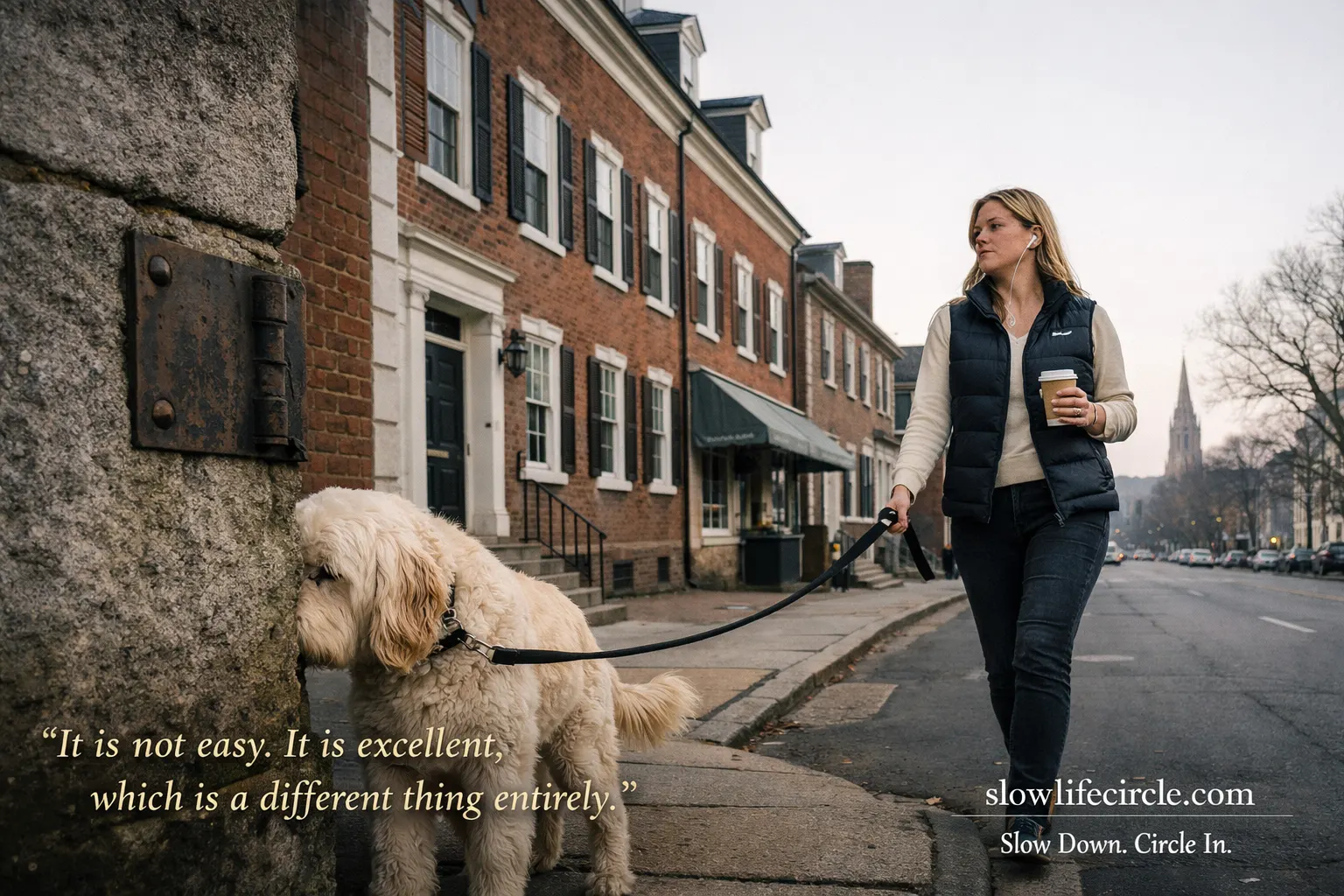
It is 7:42 in the morning on a Tuesday in January, and a woman in a Patagonia vest is walking her labradoodle past a 250-year-old colonial on Nassau Street, earbuds in, coffee from Small World in her other hand. She passes a Nobel laureate she vaguely recognizes, doesn’t stop, because this is Princeton and you don’t. The dog investigates a Revolutionary War-era gatepost. A PhD student on a bicycle cuts around them both, late for something. The local hardware store — open since 1960 — has its awning down against the cold. A bakery is already full.
This is what Tuesday looks like here. Not a weekend. Not parents’ weekend at the University. A Tuesday, in January, in a town of roughly 31,000 people that has somehow assembled the walkable density of a small city, the institutional gravity of a world-class research hub, and property tax bills that would make your accountant put down her coffee.
Princeton is, without question, one of the most intellectually stimulating places to live in the United States — and one of the most expensive per square foot of any town in New Jersey. Those two facts are not unrelated. The question this article is going to answer, with data and without flinching, is whether Princeton’s extraordinary offer justifies its extraordinary cost — and, more specifically, whether it justifies it for you.
Princeton rewards people who thrive on access: to ideas, to culture, to educated neighbors, to a genuinely walkable downtown, to two major cities within an hour or so. It tends to humble people who assumed that “good suburb” meant “easy suburb.” It is not easy. It is excellent, which is a different thing entirely.
Part II: The Number That Will Either Comfort You or End the Conversation
Every Move Here article builds from the same foundation: what does it actually cost to live here, and what does that cost mean in practical, weekly, monthly terms? Princeton’s numbers are not subtle. Here they are, sourced and dated, with no flattering omissions.
| Data Category | Princeton, NJ | National Average | Difference | Source |
|---|---|---|---|---|
| Median Home Value (08540 ZIP) | $974,452 | ~$420,000 | +132% | Zillow, “08540 Home Values,” Jan 2026 |
| Median Home Price — Princeton City | $1.3M | ~$420,000 | +210% | Redfin, “Princeton Housing Market,” Dec 2025 |
| Avg. Rent — 1-Bedroom | $2,650/mo | ~$1,636/mo | +62% | Apartments.com, “Princeton Rent Trends,” Nov 2025 |
| Avg. Rent — 2-Bedroom | $3,271/mo | ~$1,900/mo | +72% | RentCafe / Yardi Matrix, “Princeton Market,” 2025 |
| Property Tax Rate (effective) | 2.43% | 0.99% | +1.44 pts | Ownwell, “Princeton Property Tax Trends,” 2025 |
| Typical Annual Property Tax Bill | $17,000–$22,000 | ~$2,690 | +535% | Ownwell; local realtor data, Mercer County 2024–25 |
| NJ State Income Tax | 1.4%–10.75% | n/a (varies) | — | NJ Division of Taxation, Tax Year 2025 |
| Groceries Index | ~110–115 | 100 | +10–15 pts | ⚠️ Reported — C2ER / resident accounts, 2025 |
| Overall COL vs. National Average | ~+61% | 100 | +61 pts | ⚠️ Reported — Apartments.com / C2ER data composite, 2025 |
| Median Household Income | ~$130,000+ | ~$80,000 | +63% | ⚠️ Reported — U.S. Census ACS 2023 estimate |
Let’s translate. At Princeton’s effective property tax rate of 2.43%, a home purchased at the 08540 ZIP median of roughly $975,000 carries an annual tax bill of approximately $23,690. That is $1,974 per month — before your mortgage, insurance, or utilities. [(Source: Ownwell, “Princeton NJ Property Tax Trends,” 2025. ownwell.com/trends/new-jersey/mercer-county/princeton)] The actual median bill for current owners tends to run $17,000–$22,000 annually because many homes carry assessed values below their market price, but buyers entering at today’s prices should budget toward the higher end of that range.
At a 7% mortgage rate on a 20%-down loan against a $975,000 purchase, your principal and interest payment is roughly $5,200 per month. Add the property tax at $1,974, homeowner’s insurance at approximately $200, and you are at roughly $7,400 per month before you have purchased a single bag of groceries. Princeton’s median household income of $130,000+ means the people who live here can, in aggregate, carry these costs — but it means the margin for financial error is slimmer than the listing agent will mention.
The Sage’s Take: Princeton’s cost structure is not a bug in the program — it is the program. The town’s exceptional schools, walkable core, cultural density, and employer ecosystem are underwritten by those property taxes and sustained by the gravitational pull of the University. You are not paying for square footage; you are paying for access to one of the most intellectually alive communities in the country. Whether that trade makes sense for your household depends entirely on what you need from a place to live — and we will get into that shortly.
Is Princeton Actually Your Town? — A 5-Question Decision Tool
Not a personality quiz. A calibration tool. Answer honestly; the scoring key is at the end of the article.
- The Dinky Question. Your commute to NYC involves a 5-minute shuttle train (the Princeton “Dinky”), a transfer at Princeton Junction, and an 80-minute NJ Transit ride to Penn Station — totaling roughly 90 minutes door-to-door. Five days a week. Does that sentence make you wince, shrug, or actually sound kind of fine because you can read the whole way?
A) Wince — I need to be in the city in under an hour B) Shrug — 90 minutes is fine if the train is reliable C) That sounds fine, honestly - The Tax Math Question. Your annual property tax bill on a median-priced Princeton home will likely land between $17,000 and $23,000 per year. That figure funds the schools, the parks, and the infrastructure. Your reaction is:
A) That’s a dealbreaker B) I expected it to be high; I’ll factor it in C) What’s the school rating? - The Saturday Morning Question. Princeton’s downtown — Nassau Street and its radiating blocks — is genuinely walkable and genuinely good. But the wider town ranges from walkable to car-dependent fairly quickly. If the nearest grocery store requires a 10-minute drive from your specific address, is that:
A) Unacceptable — I came here for walkability B) Normal — I own a car C) Fine, as long as there’s good delivery - The University Question. Princeton University is not merely in the town; it is, in meaningful ways, the town’s metabolism. Its presence means world-class lectures open to the public, a vibrant arts calendar, and foot traffic that keeps Nassau Street alive year-round. It also means graduation weekends with zero parking, a rental market partly driven by graduate student housing demand, and a cultural atmosphere that some residents describe as intellectually stimulating and others find quietly intimidating. Your honest response:
A) I came here for exactly that energy B) I can take it or leave it C) This might not be my scene - The Renter’s Question. If you are not buying, a 1-bedroom apartment in Princeton averages $2,650/month — 62% above the national average. A 2-bedroom averages $3,271. With the income needed to live comfortably here as a renter, you are competing for housing with University affiliates, pharma professionals, and the occasional Nobel laureate’s postdoc. Your sense of that market is:
A) That’s fine — my income supports it B) Tight but manageable C) I need to look at neighboring towns for the rental phase
Scoring key appears at the end of the article (Section J).
Part III: Who Thrives Here (And Who Quietly Regrets the Lease)
Princeton is not for everyone, and it knows it. The following persona assessments are grounded in verified market data and community-sourced sentiment from Niche reviews, Reddit threads, and local press coverage — not marketing assumptions.
The University-Adjacent Professional
Academic researcher, administrator, or tech professional tethered to the Princeton University ecosystem or the Route 1 pharma corridor (Bristol-Myers Squibb, Novo Nordisk, Integra LifeSciences, ETS).
What Princeton gives them: A five-minute walk or bike ride to work, a professional social network embedded in the neighborhood, open access to lectures, concerts, and art exhibitions. The intellectual density of daily life is genuinely rare in American suburbia.
What Princeton costs them: Housing prices that are calibrated to institutional salaries. A researcher on a postdoc stipend will rent, not buy — and will feel that $2,650/month for a 1-bedroom keenly. [(Source: Apartments.com, Nov 2025)]
Best neighborhood: Witherspoon-Jackson Historic District or Downtown core — 1-bedroom rentals from ~$2,200 (older buildings via Nassau Street Properties) to $3,000+ in newer developments. [(⚠️ Reported — WalkablePrinceton.com, Nov 2025)]
Sage’s Fit Score: ⭐⭐⭐⭐⭐ — This is precisely the person Princeton was built for. The only friction is financial, and it is real friction.
The Family With School-Age Children
Two-income household, primary filter is schools, willing to stretch on housing to avoid private school tuition.
What Princeton gives them: Princeton Public Schools carries an A+ rating from Niche (ranked among New Jersey’s top 6 school districts in 2026) and a GreatSchools rating of 8/10 for both Princeton Middle School and Princeton High School. [(Source: Niche.com, “2026 Best School Districts NJ”; Homes.com school data, 2025)] Princeton High School’s average SAT score of 1,370 and ACT of 31 place it meaningfully above state and national averages. Student-teacher ratio: 12:1 at the high school, 11:1 at the middle school. The district is genuinely distinguished — not just by rating, but by what students report about the culture of academic expectation. (Which one Niche reviewer diplomatically called “hyper-competitive.”)
What Princeton costs them: The housing buy-in. A family purchasing a 4-bedroom home adequate for two adults and two children is likely looking at $1.3M–$1.8M in Princeton proper, with property tax bills of $22,000–$30,000 annually. Some families find the academic pressure at the high school genuinely intense and take time to realize it before moving. Verify that intensity is what you want, not just what the rating implies.
Best neighborhood: Riverside — family-oriented, near Carnegie Lake and excellent parks, slightly lower entry prices than the downtown core, feeding into strong elementary schools. Median sale prices: $900,000–$1.2M range. [(⚠️ Reported — Redfin neighborhood data, 2025)]
Sage’s Fit Score: ⭐⭐⭐⭐⭐ — If you are buying Princeton for the schools, you are getting what you paid for. Just confirm the specific elementary school assignment for your address before closing, because zone lines do not always follow neighborhood names.
The Remote Worker / Location-Independent Professional
Untethered from a commute, optimizing for quality of daily life, cost-of-living sweet spot, and fast internet.
What Princeton gives them: A walkable downtown that functions as a genuine daily ecosystem — coffee shops, a year-round farmers’ market, independent bookstores, restaurants worth eating at on a Wednesday. Fiber-optic internet access. [(Source: Dwellics.com, “Princeton NJ Pros and Cons,” 2025)] The University’s public programming fills weekday afternoons with something better than a content algorithm.
What Princeton costs them: The premium. Princeton’s COL is approximately 61% above the national average — which, for a remote worker whose income is indexed to a lower-cost market, is a meaningful headwind. The question to ask yourself honestly: are you bringing a San Francisco salary to a New Jersey town, or a Midwest salary to a New York-adjacent market? The answer matters quite a lot.
Best neighborhood: Downtown / Nassau Street corridor for the walker who wants maximum daily-life utility. Western Section for the remote worker who wants more space per dollar and can live car-dependent. Entry price differential between these two is substantial.
Sage’s Fit Score: ⭐⭐⭐⭐ — Outstanding quality of life, provided the income geography works. One star docked for cost exposure that remote workers in lower-indexed markets will feel acutely.
The Near-Retiree / Downsizer
Leaving a larger home or high-cost market, seeking walkability, cultural richness, and strong healthcare access.
What Princeton gives them: Penn Medicine Princeton Medical Center — a 355-bed teaching hospital in adjacent Plainsboro with a helipad, a full cancer center currently expanding by $401 million, and the backing of the Penn Medicine health system. [(Source: Wikipedia, “Penn Medicine Princeton Medical Center,” updated Jan 2026; ROI-NJ, “Penn Medicine Breaks Ground on Cancer Center,” Oct 2025)] The town is walkable where it matters most — doctor’s offices, pharmacy, restaurants, the library — without requiring the full-time physical engagement of a dense city. The cultural calendar driven by the University is essentially free.
What Princeton costs them: The property tax bill does not care that you are on a fixed income or are downsizing from a larger home. A condo or townhome in Princeton priced at $700,000–$800,000 still generates $17,000–$19,000 per year in property taxes. NJ also taxes most retirement income above certain thresholds (though Social Security is exempt). This math deserves a full session with a tax advisor before you sign anything.
Best neighborhood: Downtown Princeton / Witherspoon area for maximum walkability; or one of the newer condo developments near the Princeton Shopping Center for lower-maintenance living. [(📍 Community — local realtor accounts, 2025)]
Sage’s Fit Score: ⭐⭐⭐⭐ — Culturally and medically, Princeton over-delivers. The tax calculus for retirees needs careful pre-move modeling. One conversation with a NJ-licensed financial planner before you arrive could save considerable grief six months in.
The City Escapee (From NYC or Philadelphia)
Moving from a dense metro, trading a studio for square footage, worried about losing cultural access and gaining nothing but a longer commute.
What Princeton gives them: More than they expected, honestly. The downtown is genuinely alive — not “for a suburb” alive, but actually alive. The food scene, cultural programming, and pedestrian infrastructure are legitimate. The New York commute is real (roughly 80–90 minutes by train door-to-door) but manageable for hybrid schedules. The Philadelphia commute is meaningfully better, at 45–55 minutes by car or 90–105 minutes by train. [(Source: Rome2Rio / NJ Transit data, 2025; Daily Princetonian commute analysis, Jan 2023)]
What Princeton costs them: The parts of city life that Princeton genuinely cannot replicate: late-night anything, spontaneous live music, density of cultural activity on weekday evenings, and the ambient hum of a city that doesn’t turn its volume down at 10pm. Princeton is exceptional. It does not replace New York. It is its own thing.
Best neighborhood: Downtown core — within walking distance of Nassau Street — for the most city-adjacent daily experience. Plan on a budget of $1M+ for a 2-bedroom condo or townhome in that radius.
Sage’s Fit Score: ⭐⭐⭐⭐ — Better than most city escapees expect; less than a few will be willing to admit when the initial adjustment hits around month four.
Part IV: The Dinky, the NEC, and the Question of Getting There
Princeton’s transit situation is singular and worth understanding precisely before you build your life around it. The town is served by the Princeton Branch of NJ Transit — locally and affectionately called “the Dinky” — a two-car shuttle operating a 2.7-mile run between Princeton Station and Princeton Junction. [(Source: Wikipedia, “Princeton Junction Station,” updated Jan 2026)] At Princeton Junction, you connect to the Northeast Corridor Line for service to New York Penn Station and Trenton (for Philadelphia connections). This system works. It does not work on New York commuter terms.
| Destination | Mode | Avg. Peak Time | Frequency / Cost | Source |
|---|---|---|---|---|
| New York Penn Station | Train (Dinky + NEC) | ~80–90 min | Every 30 min; ~$13–21/trip | NJ Transit; Rome2Rio, 2025 |
| New York Penn Station | Drive (off-peak) | ~70–80 min | Tolls + parking ~$30–60/day | Google Maps peak estimate |
| Philadelphia 30th Street | Drive | ~50–60 min | ~$6–10 in tolls | Google Maps peak estimate |
| Philadelphia 30th Street | Train (NEC + SEPTA) | ~90–105 min avg. | Varies; transfer at Trenton | Daily Princetonian analysis, Jan 2023 |
| Newark Liberty Airport | Drive | ~60–75 min peak | ~$40–60 parking/day | Google Maps estimate |
| Philadelphia International Airport | Drive | ~50–65 min | ~$25–40 parking/day | Google Maps estimate |
The Dinky runs every 30 minutes during peak hours and less frequently on evenings and weekends. The transfer at Princeton Junction adds roughly 10–15 minutes of wait time. For a five-day-a-week NYC commuter, this means your door-to-desk time is genuinely closer to 90 minutes than the “just over an hour” that some listings imply. At $13–21 per trip each way, the monthly rail cost approaches $550–840 — before the monthly parking pass at Princeton Junction, which has a wait list. [(⚠️ Reported — Princeton Junction parking waitlist: multiple community accounts, 2024–25)]
For hybrid workers making two or three trips to the city per week, the train math is comfortable and the commute genuinely pleasant. For five-day commuters to New York who need desk time by 9am, Princeton rewards serious prior modeling of the actual schedule — not the best-case scenario version.
Part V: Schools, Safety, and the Infrastructure You Actually Use
5a — The Schools (With the Data, Not Just the Reputation)
Princeton Public Schools is a genuine standout — not in the “every suburb tells you it has great schools” way, but in the data way. Niche rates the district A+ overall and ranks it among New Jersey’s top six school districts in its 2026 rankings, placing it in elite company in a state that treats its school rankings as a competitive sport. [(Source: Niche.com, “2026 Best School Districts in New Jersey,” 2026)] The district serves approximately 3,800 students across six schools (four elementary K–5, one middle school, one high school).
Princeton High School (151 Moore St): GreatSchools 8/10, Niche A+, average SAT 1,370, average ACT 31, student-teacher ratio 12:1, enrollment ~1,532. Princeton Middle School: GreatSchools 8/10, Niche A, student-teacher ratio 11:1. [(Source: Homes.com school data citing GreatSchools and Niche, 2025)] The district’s elementary schools — Johnson Park, Riverside, Littlebrook, and Community Park — feed into the middle and high school pipeline. A Niche student reviewer offers a note worth filing: “the extent to which [the district] equips students creates a hyper-competitive environment.” That is useful context for families whose children may not be academic pressure-seekers by temperament.
One critical practical note: elementary school assignments in Princeton are address-specific, and zone lines do not always follow neighborhood names. Confirm the exact school assignment for your specific property before making an offer. This is not a rumor — it is a documented source of post-move surprise.
5b — Safety
Princeton is one of the safer municipalities in New Jersey — and the data is consistent enough across sources to say so without hedging excessively. According to FBI crime data for calendar year 2024 (released September 2025), Princeton recorded 9 violent crimes — equivalent to 29 per 100,000 residents, which is 92.1% below the national average. Total crime rate: 763 per 100,000, which is 67.2% below the U.S. average. [(Source: AreaVibes, “Princeton NJ Crime,” citing FBI 2024 data, released Sept 2025. areavibes.com/princeton-nj/crime)] CrimeGrade rates Princeton’s violent crime at an A, placing it in the 91st percentile for safety nationally. [(Source: CrimeGrade.org, “Princeton NJ,” 2025)]
The caveat, and it is worth noting: property crime has ticked upward slightly — from 6.2 per 1,000 residents in 2022 to 7.3 per 1,000 in 2024. [(Source: SafeWise / Patch, “Princeton Named Among Top 20 Safest Cities in NJ,” 2024)] Princeton ranks 19th on SafeWise’s 2024 safest cities list for New Jersey. The practical implication: lock your car. This is not a dramatic warning; it is the primary category of local crime.
5c — Daily Infrastructure
Healthcare: Penn Medicine Princeton Medical Center — a 355-bed academic medical center in adjacent Plainsboro, owned by the Penn Medicine health system — is the primary facility for the area. In October 2025, Penn Medicine broke ground on a $401 million expansion of the Abramson Cancer Center on the PMC campus. [(Source: ROI-NJ, “Penn Medicine Breaks Ground on Cancer Center,” Oct 21, 2025)] This is a legitimately strong regional hospital, not a community clinic.
Groceries: Princeton has a McCaffrey’s (upscale independent), a Whole Foods, a ShopRite, and a Trader Joe’s within reasonable driving distance — with the Whole Foods on Nassau Street accessible on foot from the downtown core. The Saturday morning Princeton Farmers Market, held year-round in Palmer Square, is not a farmers market the way some towns use that phrase as a synonym for two vegetable tents; it is an actual weekly market with real food that residents actually use. [(📍 Community — consistent resident reports, 2024–25)]
One quality-of-life detail that rarely appears in guides but residents cite consistently: the Princeton Public Library. Renovated and expanded, it functions as the town’s living room — programming seven days a week, a genuinely good children’s section, and the particular social function of a library in an academic town, which is that it takes its events seriously. Several residents on Niche and in local press describe it as what they use instead of a community center. [(📍 Community — Niche reviews, 2024–25)]
The Sage’s Honest Verdict on Princeton’s Core Trade-off
Princeton is one of those rare American towns that actually delivers on the full bill of goods: the school system is real, the walkability is real, the cultural life is real, and the hospital is excellent. The cost is also real — not merely “higher than average” real, but “will restructure your monthly budget in ways you did not fully model before the offer” real. The people who leave Princeton within three years are not the ones who hated it; they are the ones who did not accurately price the property tax, the home-price premium, and the commute before they committed. Run the actual numbers on your specific address and income before you fall in love with the dining room.
Part VI: What You Learn in Month Six (That No One Tells You in Month One)
All items below are 📍 Community-Reported — sourced from Niche resident reviews, Reddit threads (r/newjersey, r/Princeton), local press, and Walkable Princeton community coverage, 2024–2025. Weight accordingly; verify independently before acting on any item.
- The Dinky’s weekend schedule is meaningfully thinner than its weekday one, which catches newcomers off guard the first time they try to catch a Sunday afternoon train and discover it runs hourly.
- Princeton Junction’s commuter parking lot — your access point to the NEC — has a wait list. Drive-up parking exists, but arriving at 8am during a peak season and finding a spot is not guaranteed. Many residents pay for parking at the lot in Hamilton or Metropark and reverse-commute to the station.
- The academic calendar governs the town’s pulse in ways you will not notice until graduation weekend, when Nassau Street becomes briefly impassable and every restaurant within four blocks of Palmer Square requires a reservation you forgot to make in October.
- Downtown Princeton’s walkability is excellent — Walk Score ~84. The town’s residential neighborhoods, particularly west of Route 27, are significantly more car-dependent than first-time visitors assume from a Nassau Street stroll.
- Many residents are pleasantly surprised by the openness of Princeton University’s campus and programming to non-affiliates. Free public lectures, open art exhibitions at the Art Museum, and outdoor concerts are part of daily life here in a way that is easy to underestimate until you are living it.
- Property tax assessment appeals exist and are used by residents, with a filing deadline of April 1 each year with the Mercer County Board of Taxation. Some homeowners report success; others report their appeals were denied despite what felt like significant increases. Worth knowing before year one’s bill arrives.
- The elementary school zone assignment genuinely matters. Two houses on the same street can feed into different elementary schools. Multiple new residents cite this as the most important thing they wish someone had told them before choosing their specific address.
- The restaurant scene on Nassau Street and its surrounding blocks is legitimate, diverse, and consistent — but the town closes earlier than a city-dweller expects. By 10pm on a weeknight, your options are limited. This is not a criticism; it is a calibration.
Part VII: Where in Princeton You Actually Belong
Princeton is a single municipality (consolidated from the former Borough and Township in 2013) but its neighborhoods vary meaningfully in character, price, walkability, and commuter access. The following guide assumes you have already decided Princeton is right and now need to know which part of Princeton is right.
| Neighborhood | Best For | Median Price / Rent | Walk Score | School Zone (Elem.) | Sage’s One-Liner |
|---|---|---|---|---|---|
| Downtown / Nassau Street Core | University-adjacent professionals; walkers; renters in new buildings | $700K–$1.3M buy; $2,650–$3,400 rent | ~84 (Very Walkable) | Witherspoon/Community Park | The highest-utility, highest-cost neighborhood in the 08540: everything you moved here for is within walking distance, and the price makes sure you never forget it. |
| Witherspoon-Jackson Historic District | History-minded buyers; renters seeking character buildings; diverse community | $800K–$1.2M buy; $2,200–$2,700 rent | ~80 (Very Walkable) | Community Park / Johnson Park | Princeton’s most architecturally textured neighborhood, with the town’s longest roots and the most authentic residential feel — provided you can navigate the parking on game days. |
| Riverside / Carnegie Lake Area | Families with children; outdoor-activity households; buyers seeking slightly more space | $900K–$1.4M buy | ~60–70 (Somewhat Walkable) | Riverside Elementary | The neighborhood that delivers on the “space without sacrifice” promise — mostly, and within a Princeton price context, which recalibrates your definition of “space.” |
| Western Section (Rosedale Road area) | Buyers seeking large lots and maximum privacy; second-car households | $1.2M–$2.5M+ buy | ~30–45 (Car-Dependent) | Littlebrook / Johnson Park | Princeton’s most suburban face — large parcels, wooded setbacks, and the quietest version of an already-quiet town; you will need the car you thought you could leave behind. |
| Princeton Landing / Forrestal Village | Commuters prioritizing Route 1 access; renters in larger apartment complexes | $500K–$850K buy; $2,400–$3,200 rent | ~40–55 (Car-Dependent) | Community Park | The most affordable face of Princeton proper — which is a sentence that requires its own moment of reflection — with good highway access and the shortest commute to the pharma corridor. |
Walk Scores: ⚠️ Reported — Walk Score data 2024–25; school zone assignments: confirm via Princeton Public Schools district office before purchase.
Part VIII: Before You Sign — The Sage’s 10-Point Princeton Pre-Move Checklist
These are not generic moving tips. They are the specific due-diligence items that Princeton’s particular character — its administrative structure, commuter infrastructure, tax system, and school geography — makes especially important.
- Confirm your exact school assignment. Contact Princeton Public Schools District Office with your specific street address before making an offer. Zone lines do not always follow neighborhood names, and two neighboring streets can feed into different elementary schools.
- Drive your actual commute at actual peak hours. If you are commuting by train, take the Dinky to Princeton Junction and catch the 7:45am NEC toward New York on a Thursday. Experience the transfer, the wait, and the platform conditions before signing a lease.
- Confirm Princeton Junction parking status. Commuter parking at Princeton Junction has a wait list. Before assuming you will park there daily, call West Windsor Township or NJ Transit’s lot management to confirm current availability and wait times.
- Run the full tax math for your specific property. Look up the current assessed value and tax bill for any home you are seriously considering on Mercer County’s tax records, not just the listing’s estimated figure. The assessment and the purchase price can diverge significantly, especially in a rising market.
- Model your post-purchase monthly budget with the actual property tax number. Add principal + interest + property tax + insurance + utilities before falling in love with any home. The monthly cash obligation at Princeton prices can surprise buyers who have only estimated.
- Visit Nassau Street on a Wednesday evening, not a Saturday afternoon. Saturday Princeton is its best-dressed self. Wednesday Princeton is your actual daily life. Know the difference before you commit.
- Check the specific apartment building or complex for Dinky shuttle proximity. The Princeton Station was relocated in 2018 from its original Nassau Street-adjacent location to a site nearer to the athletic facilities — a move that lengthened the walk from downtown for many residents. Confirm walking time from your specific address to the current station if transit is part of your daily life.
- Verify broadband provider and speeds at your exact address. Princeton has good fixed-line fiber availability in most of the residential core, but coverage is not universal in every street in the Western Section. Remote workers should confirm before signing.
- Research Princeton’s fourth-round affordable housing plan for 2025–2035. The town has committed to adding 276 new affordable housing units in targeted infill locations by 2035. [(Source: WalkablePrinceton.com, “Town of Princeton Embraces Smart Growth,” June 2025)] If you are buying near a proposed development site, confirm the plan status with the Princeton Planning Board before assuming the streetscape is fixed.
- If retiring to Princeton, consult a NJ-licensed tax advisor before arriving. New Jersey’s retirement income taxation structure — which exempts Social Security but taxes pension and retirement account income above certain thresholds — combined with Princeton’s property tax bill, creates a tax posture that deserves a full modeling session before you commit.
Part IX: So. Should You Move Here?
There is no honest universal answer to that question, and any article that gives you one is selling something.
Here is the persona-differentiated version. If you are a university professional, a pharma or biotech researcher, or a family whose primary filter is public school quality — and if your household income supports Princeton’s cost structure without requiring financial contortion — then yes, Princeton almost certainly delivers. The schools are real. The walkability is real. The cultural life is rare, and it is free. The safety record is excellent. The hospital is excellent. The intellectual quality of daily life in this town is something that residents who leave invariably say they miss most.
If you are a five-day-a-week New York commuter who romanticized the train idea without running the 80-to-90-minute round trip math, Princeton will require an honest renegotiation around month three. If you are a renter whose income does not comfortably accommodate $2,650+ monthly for a one-bedroom, there are adjacent towns — West Windsor, Lawrence, Lawrenceville, and Plainsboro — that share significant pieces of the Princeton geographic advantage at meaningfully lower price points. And if you are a near-retiree who has not yet had the conversation with a tax advisor about what New Jersey’s income and property tax structure does to your fixed income, please have that conversation before you move the furniture.
For almost everyone else — the hybrid workers, the culture-seekers, the families who did the math and found it pencils out, the researchers and professionals who will use every single thing this town offers — Princeton will hand you back more than you put in. It is not a compromise between life and logistics. It is, for the right person, the one American town that seems to have figured out how to have it both ways.
On a Tuesday morning in January, a labradoodle is still investigating that Revolutionary War-era gatepost on Nassau Street. The owner has long since disappeared into the coffee shop. The Dinky is making its five-minute run to Princeton Junction. And somewhere on the NEC platform, 131 trains are lining up for another day. The question is whether you are on one of them — and whether, six months in, you will be glad you are.
Part X: Quiz Answers & Full Source Compilation
Quiz Answer Key — “Is Princeton Actually Your Town?”
Question 1 (The Dinky): A = Princeton is likely not your optimal commuter town; consider West Windsor or Plainsboro for shorter drive-to-station options. B or C = Princeton’s transit situation is manageable for you; proceed.
Question 2 (The Tax Math): A = Princeton’s ownership cost structure will cause sustained financial stress; investigate renting or neighboring towns. B or C = You have done the math; you are ready for the next step.
Question 3 (Saturday Morning): A = Prioritize the downtown core and Witherspoon-Jackson neighborhoods specifically; avoid the Western Section if walkability is non-negotiable. B or C = You have realistic suburban expectations; any neighborhood fits.
Question 4 (The University): A = Princeton is particularly well-suited to you. B = Neutral; Princeton works regardless. C = Princeton is still a fine town, but you may find West Windsor or Lawrenceville a more comfortable daily-life fit if the university atmosphere is not your draw.
Question 5 (The Renter): A = Proceed. B = Budget carefully and explore Nassau Street Properties for older buildings at slightly lower rates. C = Price out West Windsor, Plainsboro, and Lawrenceville as a base with Princeton access before committing.
Mostly A answers across the board: Princeton is a stretch for your situation; neighboring towns offer significant value at lower cost. Mostly B or C: Princeton is a strong candidate. Run the full budget model and proceed to a neighborhood visit.
Full Source Compilation — All ✅ Verified Citations
- Zillow, “08540 Home Values,” Jan 2026. zillow.com/home-values/61100/princeton-nj-08540/
- Redfin, “Princeton Housing Market,” Dec 2025. redfin.com/city/15686/NJ/Princeton/housing-market
- Apartments.com, “Princeton Rent Market Trends,” Nov 2025 (via WalkablePrinceton.com analysis). walkableprinceton.com/2025/11/16/how-much-does-it-cost-to-rent-in-princeton-in-2025/
- RentCafe / Yardi Matrix, “Average Rent in Princeton, NJ,” 2025. rentcafe.com/average-rent-market-trends/us/nj/princeton/
- Ownwell, “Princeton NJ Property Tax Trends,” 2025. ownwell.com/en-US/trends/new-jersey/mercer-county/princeton
- NJ Division of Taxation, NJ Income Tax Rates, Tax Year 2025. state.nj.us/treasury/taxation/
- Niche.com, “2026 Best School Districts in New Jersey,” 2026. niche.com/k12/search/best-school-districts/s/new-jersey/
- Homes.com, “Princeton High School,” citing GreatSchools and Niche data, 2025. homes.com school data pages.
- Homes.com, “Princeton Middle School,” citing GreatSchools and Niche data, 2025. homes.com school data pages.
- AreaVibes, “Princeton NJ Crime Rates,” citing FBI 2024 data released Sept 2025. areavibes.com/princeton-nj/crime/
- SafeWise / Patch, “Princeton Named Among Top 20 Safest Cities in NJ,” Apr 2024. patch.com/new-jersey/princeton
- CrimeGrade.org, “Princeton NJ Violent Crime,” 2025. crimegrade.org/violent-crime-princeton-nj/
- Rome2Rio / NJ Transit, Princeton Junction to New York Penn Station train data, 2025. rome2rio.com/Train/Princeton-Junction/New-York-Penn-Station
- The Daily Princetonian, “When’s the best time to leave Princeton for NYC or Philly?,” Jan 2023. dailyprincetonian.com
- Wikipedia, “Princeton Junction Station,” updated Jan 2026. en.wikipedia.org/wiki/Princeton_Junction_station
- Wikipedia, “Penn Medicine Princeton Medical Center,” updated Jan 2026. en.wikipedia.org/wiki/Penn_Medicine_Princeton_Medical_Center
- ROI-NJ, “Penn Medicine Breaks Ground on Cancer Center at Princeton Health,” Oct 21, 2025. roi-nj.com
- WalkablePrinceton.com, “Town of Princeton Embraces Smart Growth With Proposed Sites For New Affordable Housing,” June 2025. walkableprinceton.com
- Prop:Metrics, “08540 Princeton NJ Home Prices & Demographics,” Oct 2025. prop-metrics.com/zip/08540
- Dwellics.com, “Princeton NJ Pros and Cons,” 2025. dwellics.com/state/new-jersey/proscons-in-princeton
- NeighborhoodScout, “Princeton NJ Real Estate,” Q2 2025. neighborhoodscout.com/nj/princeton/real-estate
All figures verified as of March 2026. Housing markets, school ratings, crime indices, and tax rates change. Verify current data with relevant authorities before making any relocation decision.
Discover more from
Subscribe to get the latest posts sent to your email.